
04 · Machines
Inside ASML
From a drop of tin to a pattern too small to see.
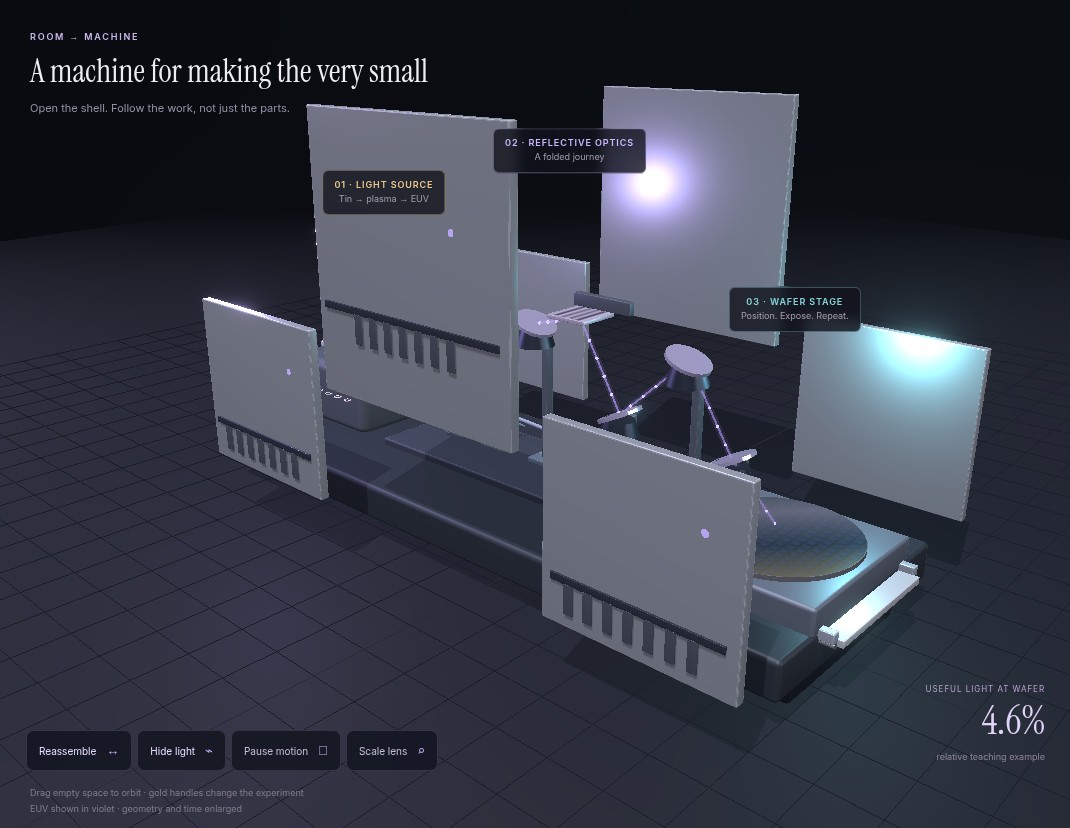
The chips inside your phone depend on light you cannot see, mirrors that cannot lose their place, and chemistry that remembers an image. Take the machine apart. Make the light. Try to print a pattern.
Five hands-on chapters · optional sound · works on phones, tablets and computers
What you'll discover
Make EUV light
Discover why timing, target shape and a tin plasma matter.
Follow the photons
Repair the path and see why vacuum and multilayer mirrors are essential.
Print with chemistry
Compare a target, a light image and the resist left after development.
Find the limits
Experiment with focus, exposure, wavelength and numerical aperture.
Connect the layers
Discover why a sharp pattern also has to be in the right place.
Meet a transistor
Control a conceptual switch and rebuild a simplified patterning cycle.
One drop. Five discoveries.
Make the pattern. Discover what it depends on.
- 01Make the lightWhy a drop of tin?
- 02Keep it aliveWhy mirrors and vacuum?
- 03Leave a markHow does light print?
- 04Find the limitsWhat stops smaller patterns?
- 05Make it matterHow does a pattern become a chip?
Science with visible boundaries
A teaching machine. Real questions.
Explore EUV principles through a representative machine and simplified calculations. Every explanation separates the science from visual translations and model assumptions. Independent lithography expert review is pending.
Independently made, not affiliated with ASML. The machine does not depict proprietary interiors. Lithography is one of many steps required to make a chip.
- EUV lithography ↗
ASML · Company technical reference
- Lithography principles ↗
ASML · Company technical reference
- How microchips are made ↗
ASML · Company technical reference
- EUV and High NA lithography ↗
ASML · Company technical reference
- Semiconductor manufacturing optics ↗
ZEISS · Supplier technical reference
- University Physics, volume 3: diffraction ↗
OpenStax · Physics textbook reference
Related films
 18:06
Business, Unpacked
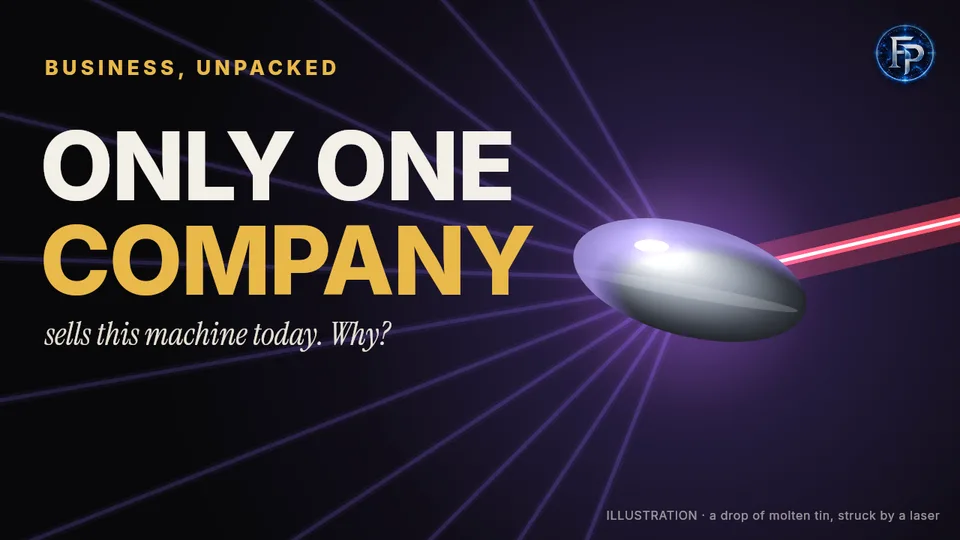
Why Can Only One Company Build This Machine?
A drop of tin through ASML's EUV machine, then the business behind it: suppliers, customers, the flywheel and what could break it.
Coming to YouTube
Related experiences