
02 · Living systems
Human
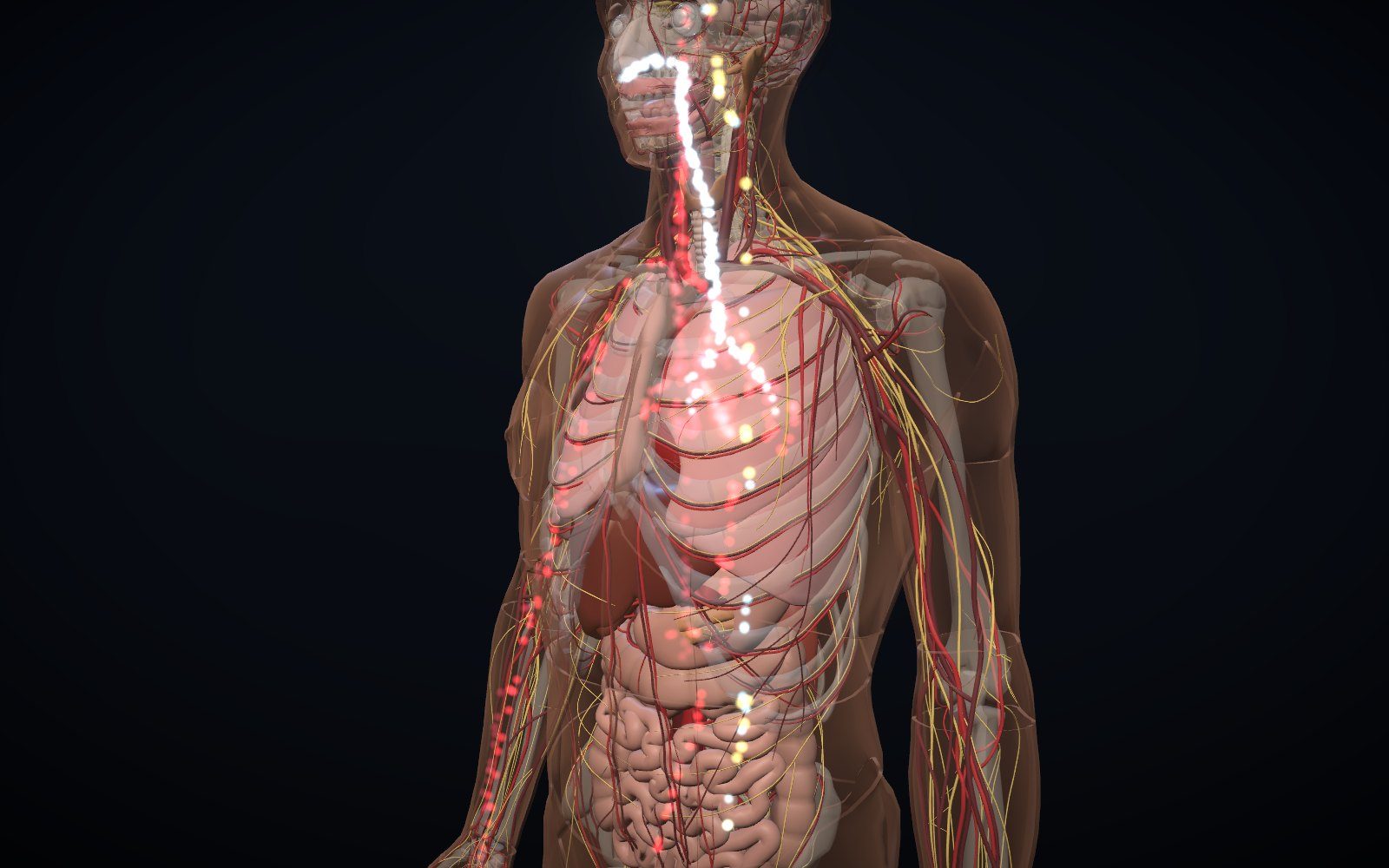
Inside the living system. Explore the system that keeps you alive.
Right now, without asking you, your body is holding its temperature, its sugar, its water and its oxygen steady while everything around it changes. Live one ordinary day inside it, and find out how.
Seven hands-on chapters · one ordinary day · sound on is best · works on phones, tablets and computers
Expert review in progress
What you'll understand
Why a body at all
Diffusion works over micrometres, not metres. Circulation is the answer to that one problem.
One heartbeat
Two pumps, four one-way doors, and a pacemaker. Take a valve out and watch the backflow.
One breath
A vast, thin surface, and a safety margin you can use up. Breathing is driven mainly by CO₂.
One meal
Thirty square metres of gut, and a sugar rise that insulin brings back down.
One drop
Kidneys filter about 180 litres a day and take back more than 99% of it.
Homeostasis
Sensors, set points and responses that push back: the pattern behind the whole day.
One ordinary day
Every organ is an answer to a problem. Meet them as the day needs them.
- 1 · 06:30Why a body?One cell, and the problem every body solves.
- 2 · 06:45One stepA decision becomes a signal becomes a movement.
- 3 · 07:00The runOne heartbeat, one breath, one red blood cell.
- 4 · 08:00BreakfastThe gut's surface, and a sugar spike that comes back down.
- 5 · 14:00Hot afternoonHeat, sweat, thirst, and one drop through a kidney.
- 6 · 18:00A small cutHow a leak seals itself.
- 7 · 22:30NightWhat stayed the same all day. Then rebuild the human.
Research, evidence & safety
Real anatomy. Labelled science.
73 questions you can ask inside the experience, built on 35 sources: textbooks, peer-reviewed measurements and open anatomy. Values are typical adult examples that vary between people; active research is labelled as such.
HUMAN is for learning how bodies work. It is not medical advice, it can't diagnose anything, and nothing in it is about your own body. Simulated failures are thought experiments, shown gently, that always recover. An expert medical review is in progress.
3D anatomy: Z-Anatomy (derived from BodyParts3D, © DBCLS), CC BY-SA 4.0.
- Pulmonary Physiology, 9e: Blood Flow to the Lung
McGraw Hill (AccessMedicine) · 2018
- Revised Estimates for the Number of Human and Bacteria Cells in the Body (Sender, Fuchs & Milo)
PLOS Biology · 2016
- Surface area of the digestive tract – revisited (Helander & Fändriks)
Scandinavian Journal of Gastroenterology · 2014
- The Number of Alveoli in the Human Lung (Ochs et al.)
American Journal of Respiratory and Critical Care Medicine · 2004
- The normal human lung: ultrastructure and morphometric estimation of diffusion capacity (Gehr, Bachofen & Weibel)
Respiration Physiology · 1978
- Why do veins appear blue? A new look at an old question (Kienle et al.)
Applied Optics · 1996
- Human nephron number: implications for health and disease (Bertram et al.)
Pediatric Nephrology · 2011
- In vivo measurement-based estimations of the human Achilles tendon moment arm (Maganaris et al.)
European Journal of Applied Physiology · 2000
Related experiences